Posts

Showing posts with the label math

Dice stuffies!!

Image
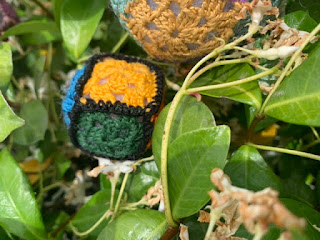
 I’M FREEEEEEEE!!!!!!!!!! … sorry. School got out today. Anyways, I’m just going to get that out of my system.  Ahem. Who wants to see crocheted Platonic solids, aka dice? This has been my project since the school carnival, and basically it’s a lot of granny squares/pentagons/triangles that are either crocheted or sewn together and stuffed kind of loosely. I took no notes and wrote no patterns, and I gave the pink/purple cube to my brother (he asked for one, I made it in his favorite color).  Also, if anyone does something like this, I’d suggest sewing it together rather than crocheting it, because whip stitches were easier and prettier than the crochet. These are DMC perle cotton and embroidery floss, in mostly random arrays of color that looked good to me. My standard 1.5mm steel hook continues to be my favorite crochet hook, and I used it here. My suggestions for anyone who wants to try something similar: sew rather than crochet them together, look up nets for polyhedr...

Sorry, dying here.

 Too busy to write, studying for APUSH, scribbled this out last week and meant to get this out earlier but forgot.  I wrote myself a calc practice problem or two, all yarn related. How many can you solve? 1. The circumference C (in stitches) of a Pi Shawl is defined as a function of its radius r (in rounds); C = 2r. The area of a circle is pi*r^2. At the point where the circumference is 4, the radius is increasing by 3 rounds/hr. What is the rate of change of the area with respect to time? (Area is measured in rounds^2)  2. The rate at which a knitter adds stitches to a blanket, in stitches per hour, can be modeled in terms of the number of stitches in the blanket (unrealistic, but still): dS/dt = 1/5(500 - S), for 0 ≤ t ≤ 25 . At time t=0, there are 10 stitches in the blanket. a) Find the rate at which the knitter adds stitches when there are 250 stitches in the blanket. b) Find S(t). c) Will the blanket be completely done (S=500) after 25 hours? How many stitches did th...

Textile traditions in fantasy, a how-to guide: part 3 of 3!

 Continuing on from the past two posts, this is the final part of a 3 part series dealing with textiles and traditions in fantasy worlds.  Today, I’m going to give a few examples of textiles in RPG worlds that I’ve built, but first I want to briefly talk about working these into a game. Working worldbuilding into an rpg plot is a complex subject and requires a lot more effort than I can give right now to cover comprehensively, but specifically for textiles, one thing I do is to describe what clothes people are wearing. This is especially useful if clothes denote something special in society, but even if they don’t, “light brown linen robes” and “neon yellow polyester raincoat” come from two very different cultures and textile traditions, and imply two very different levels of technology. Beyond clothing, consider dropping in household items — a “woven rug with geometric patterns” can give a good setting to a scene and reinforce bits of culture, or a tablecloth could be made ...

Math for Crafters: Everything is a Riemann sum, if you think about it right

 The funny thing about math is the way it sneaks into everything. Or perhaps that’s the point. I don’t know, I just love math in all its forms. So I’m bringing back something I did a while ago, Math for Crafters, and providing another brief insight into my brain. This time, I’m talking about integrals (don’t run away, I promise not to have any scary equations) and the process of adding stitches to a project. 

Magical Physics (and Mathematics) part 1: Gaming the (spell level) System

This is the first part of a complex project I’m working on for a number of unrelated reasons (sort of a bet, sort of a dare, and then I got really intrigued…) that has to do with the real-world physics of D&D5e magic, and translating magic to physics equations. The goal is to be able to write something that looks like it could be a chapter out of a physics textbook, but for D&D magic-users. The first step, though, is to be able to come up with a way of representing magical power (in game terms, spell slots) as something that can be worked with (an equation or a constant or something).  I started with a simple method that took the number and level of spell slots for a given character level and produces a single measure of magical power. I used the table for multiclass character spell slots by level (PH 165) for all my work, because I wanted something that did not require a specific class. This method should work for providing a measure of power for any class that can cast sp...

Math for Crocheters: Arithmetic Sequences and Series

 This comes courtesy of a thing I had to do the other day and an idea it gave me. Fair warning — this is kind of a math-heavy post.